
How to Check if an L2 Server Is Stable
A practical checklist for evaluating whether a Lineage 2 private server looks stable before you spend time or money on it.
Quick Answer
A practical checklist for evaluating whether a Lineage 2 private server looks stable before you spend time or money on it.
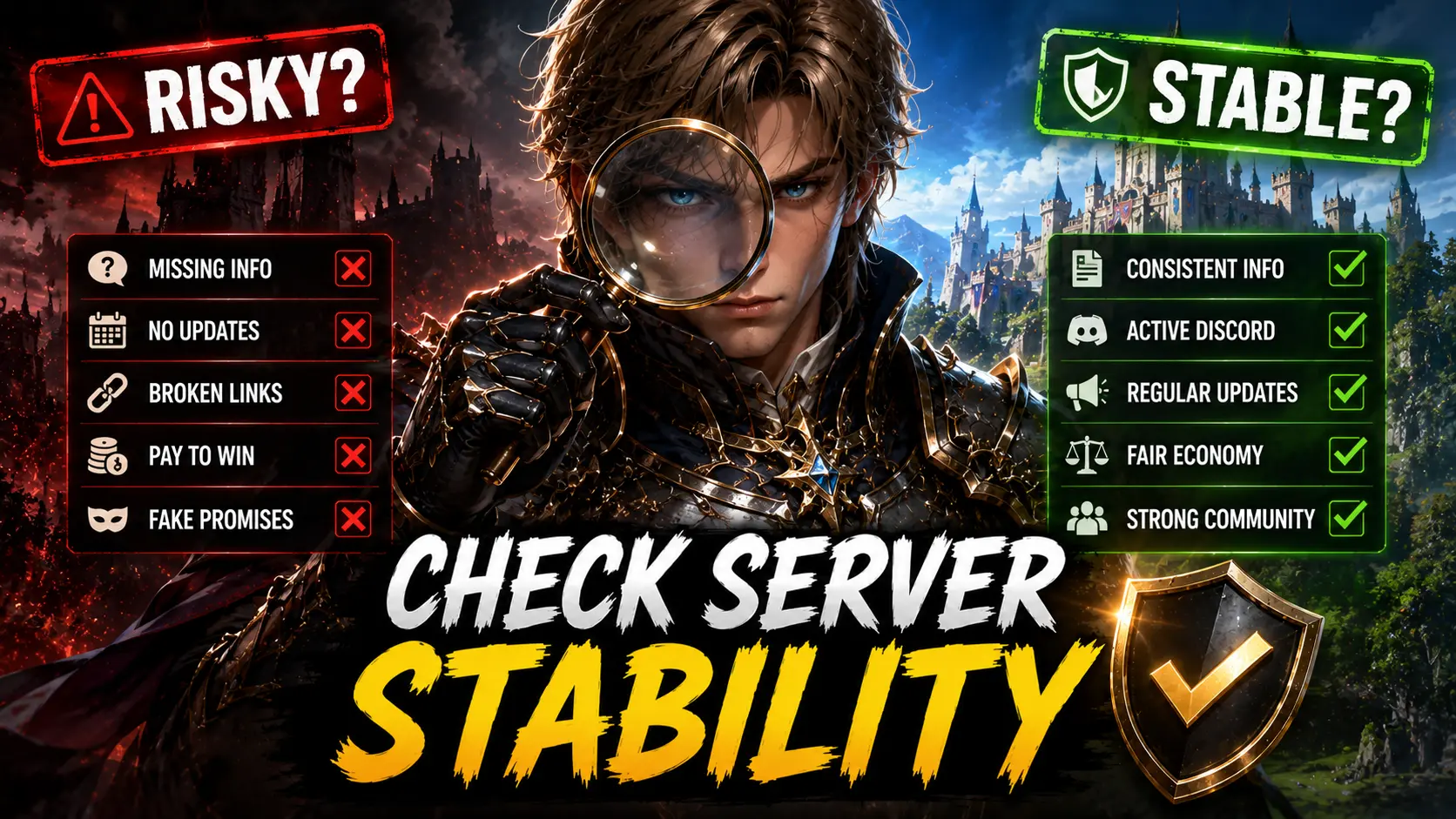
Server stability is one of the most important long-tail concerns in the Lineage 2 private server space. Players are not only asking whether a server is popular. They want to know whether it looks safe enough to invest weeks or months into. That question matters even more on New L2 Servers, Upcoming L2 Servers, and Recently Opened L2 Servers pages, where public history is naturally thinner.
Stability is not one signal. It is a pattern: consistent launch information, active communication, clear rules, and fewer contradictions between the listing, website, and community channels.
Checklist
Check whether public information stays consistent
A stable server usually looks consistent across its listing, website, and community channels. If the listing says one launch date, the website says another, and the Discord says nothing recent, that inconsistency matters.
Look at launch behavior, not only promises
For fresh projects, the best signal is often how the launch is being handled in real time. Are updates regular? Are problems acknowledged? Is the server moving between beta and launch stages clearly, or does it look confused?
Use uptime and community signals together
If a profile exposes uptime history or Discord activity, read them as context, not as standalone proof. A server can have good uptime and still fail to communicate clearly. It can also have active chat and still misrepresent rates or donation pressure.
Treat open beta and fresh launches differently
Testing projects on Lineage 2 Beta Servers should be judged with more patience than live worlds. A beta server is expected to change. A recently opened live server is expected to prove that its launch is holding together under real player pressure.
Stable does not mean risk-free
The safest practical habit is to use the listing as a starting point, then verify launch timing, rules, and community behavior on the official site before you commit. Stability is about repeated consistency, not about one attractive promise on launch day.
Key Takeaways
- Check whether public information stays consistent
- Look at launch behavior, not only promises
- Use uptime and community signals together
- Treat open beta and fresh launches differently
FAQ
What is the fastest way to spot a risky server?
Check whether the launch date, rates, and links on the listing match the official website and whether the project still communicates regularly.
Should I avoid every new server?
No. Fresh servers can be good opportunities, but they require more checking because they have less public history.
Is uptime history enough to prove stability?
Uptime is useful, but it is only one part of the picture. Communication, patch quality, and consistency between listing and official data also matter.
Related Guides
Related Server Lists
Trust And Methodology